Note
Go to the end to download the full example code.
Accelerate an EM algorithm for mixture proportions
This example uses DAAREM to accelerate a simple expectation maximization (EM) algorithm. The algorithm computes maximum-likelihood estimates of the mixture proportions in a mixture model.
The example is a Python version of the mixem analysis in the stephenslab/daarem repository.
Load the data
The data is a conditional likelihood matrix L that comes from a simulated
data set. Element L[i, k] is the likelihood of sample i under mixture
component k. The data also contains the mixture proportions x_best of
a reference solution. fetch_mixdata() downloads the
file on the first call.
import math
import time
import warnings

import matplotlib.pyplot as plt
import numpy as np
import torch
from array_api_compat import array_namespace
from pydaarem import daarem
from pydaarem.datasets import fetch_mixdata

L, x_best = fetch_mixdata()
n, m = L.shape
print(f"Loaded {n} x {m} data matrix.")
Loaded 100000 x 10 data matrix.
Define the EM update and the objective
The E step computes the posterior probability of each component for each
sample. The M step sets the mixture proportions to the mean of these
probabilities. The small value e prevents a division by zero. Each row of
L gets its own value of e, scaled by the largest value in the row.
The functions get the array library of their input with
array_api_compat.array_namespace(), and they use only functions of the
Python array API standard. Thus, the same functions work with NumPy arrays
and with PyTorch tensors. The last section of this example uses PyTorch.
e = 1e-15 * L.max(axis=1)


def mixem_update(x, L, e):
    """Do one EM update of the mixture proportions."""
    xp = array_namespace(x)
    p = L * x + e[:, None]
    p = p / xp.sum(p, axis=1, keepdims=True)
    return xp.mean(p, axis=0)


def mixobjective(x, L, e):
    """Compute the log-likelihood of the mixture proportions."""
    xp = array_namespace(x)
    y = L @ x + e
    return xp.sum(xp.log(y)) if xp.all(y > 0) else -math.inf
DAAREM can propose iterates that are not on the probability simplex. Project each iterate onto the simplex before the EM update and before the objective.
def project_iterate(x):
    """Set negative proportions to zero and scale the sum to one."""
    xp = array_namespace(x)
    x = xp.clip(x, min=0)
    return x / xp.sum(x)


def daarem_update(x, L, e):
    """Do one EM update of the projected mixture proportions."""
    return mixem_update(project_iterate(x), L, e)


def daarem_objective(x, L, e):
    """Compute the log-likelihood of the projected mixture proportions."""
    return mixobjective(project_iterate(x), L, e)
Run the basic EM updates
Start from equal mixture proportions and run 200 EM updates.
numiter = 200
x0 = np.full(m, 1 / m)

start = time.perf_counter()
x_em = x0
em_values = []
for _ in range(numiter):
    x_em = mixem_update(x_em, L, e)
    em_values.append(float(mixobjective(x_em, L, e)))
em_values = np.asarray(em_values)
print(f"Computation took {time.perf_counter() - start:.2f} seconds.")
print(f"Log-likelihood at the EM estimate is {mixobjective(x_em, L, e):.12f}.")
Computation took 0.42 seconds.
Log-likelihood at the EM estimate is -59912.068371303445.
Run the accelerated EM updates
Run the same number of updates with DAAREM. The control values are the same
as in the R analysis. tol=0 makes DAAREM run all 200 iterations, so
DAAREM gives a warning that the algorithm did not converge. This example
ignores that warning, because the run must not stop early. DAAREM gives the
arguments after objfn (here L and e) to both functions.
warnings.filterwarnings("ignore", "Algorithm did not converge", RuntimeWarning)

control = {
    "maxiter": numiter,
    "order": 10,
    "tol": 0,
    "mon_tol": 0.05,
    "kappa": 20,
    "alpha": 1.2,
}
start = time.perf_counter()
fit = daarem(x0, daarem_update, daarem_objective, L, e, control=control)
x_daarem = project_iterate(fit["par"])
daarem_values = fit["objfn_track"][1:]
print(f"Computation took {time.perf_counter() - start:.2f} seconds.")
print(f"Log-likelihood at the DAAREM estimate is {mixobjective(x_daarem, L, e):.12f}.")
Computation took 0.48 seconds.
Log-likelihood at the DAAREM estimate is -59895.960118344083.
The DAAREM estimate has a much larger log-likelihood than the EM estimate.
Plot the improvement in the solution
The vertical axis shows the difference between the log-likelihood of the reference solution and the log-likelihood at each iteration.
EM_COLOR = "#ef5f00"  # Radix orange 10
DAAREM_COLOR = "#0d9b8a"  # Radix teal 10
INK = "#60646c"  # Radix slate 11
GRID = "#e8e8ec"  # Radix slate 4

f_best = mixobjective(x_best, L, e)
iterations = np.arange(1, numiter + 1)
series = [
    ("EM", em_values, EM_COLOR),
    ("DAAREM", daarem_values, DAAREM_COLOR),
]

fig, ax = plt.subplots(figsize=(7, 4), layout="constrained")
for label, values, color in series:
    distance = f_best - values
    ax.plot(iterations, distance, color=color, linewidth=2, label=label)
    ax.annotate(
        label,
        xy=(iterations[-1], distance[-1]),
        xytext=(6, 0),
        textcoords="offset points",
        va="center",
        color=INK,
    )
ax.set_yscale("log")
ax.set_xlabel("Iteration", color=INK)
ax.set_ylabel("Distance from the reference solution", color=INK)
ax.tick_params(colors=INK)
ax.grid(True, which="major", color=GRID, linewidth=0.8)
ax.set_axisbelow(True)
for side in ("top", "right"):
    ax.spines[side].set_visible(False)
for side in ("left", "bottom"):
    ax.spines[side].set_color(GRID)
ax.legend(frameon=False, labelcolor=INK)
plt.show()
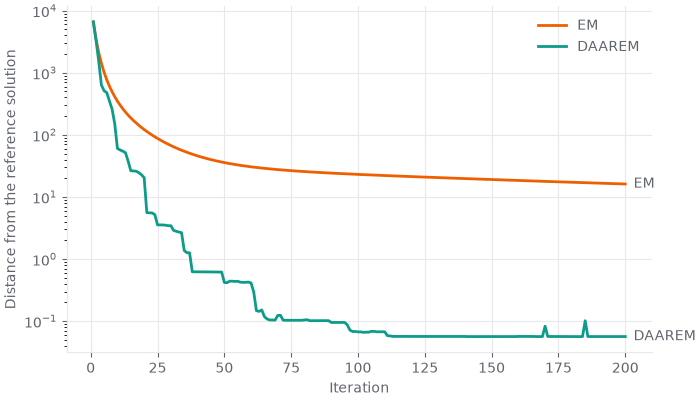
DAAREM gets much closer to the reference solution than the basic EM algorithm. After approximately 100 iterations, the improvement becomes small.
Run DAAREM with PyTorch
pydaarem computes with the array library and on the device of the start
value. Convert the data and the start value to PyTorch tensors, and run the
same fit with the same functions. To use a GPU, put the tensors on the GPU,
for example with torch.asarray(L, device="cuda").
L_torch, e_torch = torch.asarray(L), torch.asarray(e)
start = time.perf_counter()
fit_torch = daarem(
    torch.asarray(x0),
    daarem_update,
    daarem_objective,
    L_torch,
    e_torch,
    control=control,
)
x_torch = project_iterate(fit_torch["par"])
print(f"Computation took {time.perf_counter() - start:.2f} seconds.")
print(f"The result is a {type(fit_torch['par']).__name__} of {fit_torch['par'].dtype}.")
print(
    "Log-likelihood at the PyTorch DAAREM estimate is "
    f"{float(mixobjective(x_torch, L_torch, e_torch)):.12f}."
)
Computation took 0.43 seconds.
The result is a Tensor of torch.float64.
Log-likelihood at the PyTorch DAAREM estimate is -59895.960059244848.
The PyTorch result agrees with the NumPy result. The two libraries use different numerical routines, so the values can differ in the last digits.
Total running time of the script: (0 minutes 4.991 seconds)